Simplifying how staff onboard learners across the organization
80%
Reduction in student onboarding time
Role
Senior Product/UX Designer
Company
Year Up United
Product
Enterprise LMS Platform
Stage
Transformation/Consolidation
Year Up United is a skills-first nonprofit organization that prepares young adults for meaningful careers through tuition-free training and internships. As the organization expanded and launched new programs, its learning ecosystem became fragmented across multiple Learning Management Systems (LMS) platforms.
This case study outlines how UX and product design were used to consolidate three LMS platforms into a single WCAG-compliant system, improving usability, accessibility, and scalability across students, instructors, and staff.
Understanding The Challenge
Running three LMS platforms created inconsistent learning experiences, inefficient workflows, and accessibility gaps. Students encountered friction early in their journey, instructors and staff spent excessive time on manual tasks, and internal teams lacked a shared view of user needs.
At the same time, Year Up United was launching Career Connect and Career Labs, which required a learning platform capable of supporting multiple audiences, partners, and delivery models.
This meant the work had to balance day-to-day usability improvements with long-term platform design.
My Role
I work as the Lead Product and UX Designer, operating at an Associate Director level within a cross-functional team that includes Product, Research & Evaluation, Architecture, Learning Experience, Business Service Managers, Security, and Marketing.
My role focuses on setting experience direction, aligning stakeholders, and ensuring UX and product decisions drive meaningful impact:
Setting Direction: Establishing a shared understanding of user needs by synthesizing quantitative and qualitative insights across three LMS platforms.
Defining Focus: Identifying and framing the highest-impact product experience problems to guide design and product priorities.
Guiding Design: Overseeing the design of user flows and workflows to reduce friction for students, facilitators, and staff.
Driving Alignment: Aligning UX decisions with business goals, delivery constraints, and platform strategy in partnership with Product and BSMs.
Influencing Execution: Shaping backlog priorities and delivery focus to ensure user needs consistently inform what gets built.
While final delivery decisions sit with Product and Business leadership, I play a key role in influencing direction—advocating for user-centered priorities and ensuring experience impact remains central throughout planning and delivery.
Product & UX Design Process
How product and UX design shaped decisions from insight to impact.
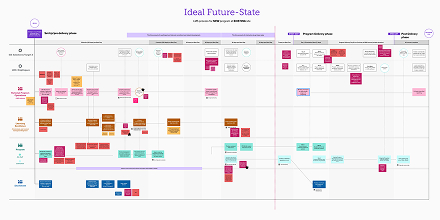
Establishing a Baseline Across Platforms
Understanding how students, instructors, and staff experienced three LMS platforms end-to-end
Identifying recurring patterns of friction across platforms
Designing scalable solutions that could work across programs and product
I used UX to align user needs with business and technical constraints, ensuring insights drove meaningful experience improvements.
Informing Decisions with Research
Gathering quantitative data through surveys and metrics
Conducting unmoderated and moderated usability testing
Auditing staff workflows to understand friction
Collecting open-ended qualitative feedback from users
Partnering with stakeholders and program teams on program strategy and business goals
Measuring Experience Impact
Establishing KPIs where none existed
Defining experience metrics with DPMs and BSMs
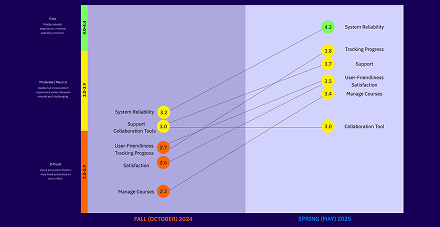
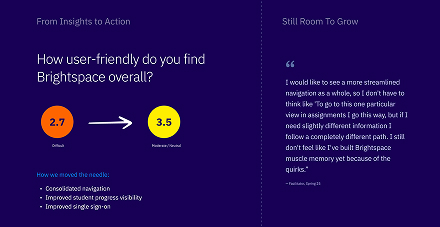
Measuring ease of use and satisfaction
Tracking progress visibility and assignment management
Evaluating system usefulness and reliability
Product and design experience feedback was separated from curriculum and research and evaluation to maintain focus on short-term adoption.
Turning Insights into Action
Synthesizing research into actionable experience themes and user problems
Sharing bi-annual user readouts to close the feedback loop and show how feedback shaped product direction
Aligning experience priorities with business goals
Supporting Product and BSMs in shaping backlog priorities
This kept user needs central as decisions moved into delivery.
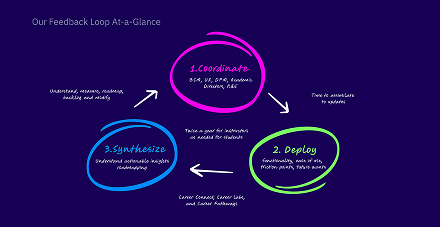
Creating a Continuous Feedback Loop
Reusing established usability KPIs to measure experience impact consistently
Reducing insight turnaround from months to 2–3 weeks
Deploying persona-specific surveys after meaningful changes to avoid noise and survey fatigue
This loop delivered faster, actionable insights and kept teams responsive as the product evolved.
Scaling the Approach Across Products
Applying the same UX framework to Career Connect and Career Labs
Adapting the process to different student, instructor and staff experiences
Cross-referencing feedback across products to identify shared opportunities
This made experience improvements repeatable and scalable across multiple products.
Tools Used
Feedback
“Brightspace has allowed for seamless curriculum integration and data reporting. The transition was smooth, and the team is excited to continue enhancing the user experience.”
Eric Papa
Director of Central Program and Delivery, YUU
Impact
Simplified Student Login
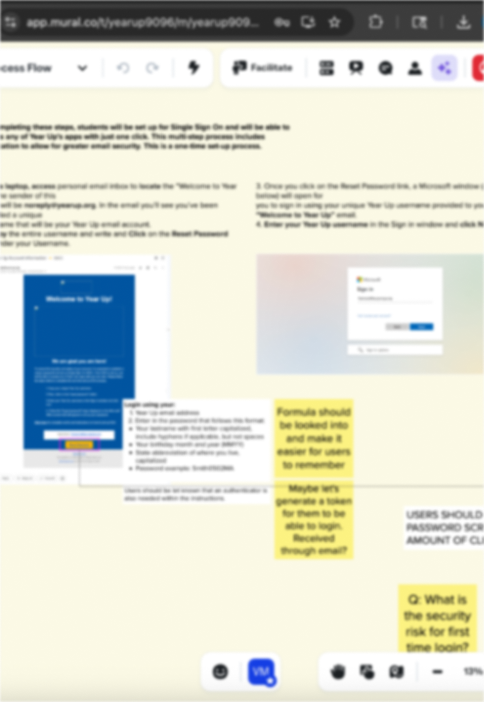
Simplifying first-login requirements improved initial access for students while maintaining security standards.
25%
Improvement in first-login success through streamlined authentication
Reduced Manual Enrollment
Replacing manual student setup with streamlined workflows reduced staff effort and significantly sped up student onboarding.
80%
Faster student onboarding through automated workflows
Improved Student Progress
By reducing friction and clarifying workflows within the LMS, learners were better able to stay on track and complete their assignments.
12.3%
Increase in assignment completion rate
Higher Learner Engagement
A simpler, more intuitive learning experience encouraged learners to interact more consistently with course content and assignments.
54x
Increase in assignment engagement compared to the previous platforms
De-Risked AI Adoption in a Regulated Domain
Consolidating learning into a single, easy-to-use platform helped learners quickly adopt the new system across learning programs.
90%
Learner adoption rate of the unified LMS
Brightspace External Recognition & Validation
The experience improvements described in this case study align closely with the outcomes highlighted in D2L’s Year Up United customer story. As a Senior Product and UX Designer, I focused on improving usability, workflows, and experience foundations across students, staff, and instructors—ensuring the platform was easier to use, easier to scale, and easier to adopt.
Many of the results featured in the D2L article—such as reduced administrative effort, increased learner engagement, and high platform adoption—were supported by this work. By partnering closely with Product, Business, and Security, I helped ensure UX insights informed real decisions while balancing enterprise constraints, contributing to a scalable approach that continues to support Year Up United and related initiatives like Career Connect and Career Labs.






.png)







.png)